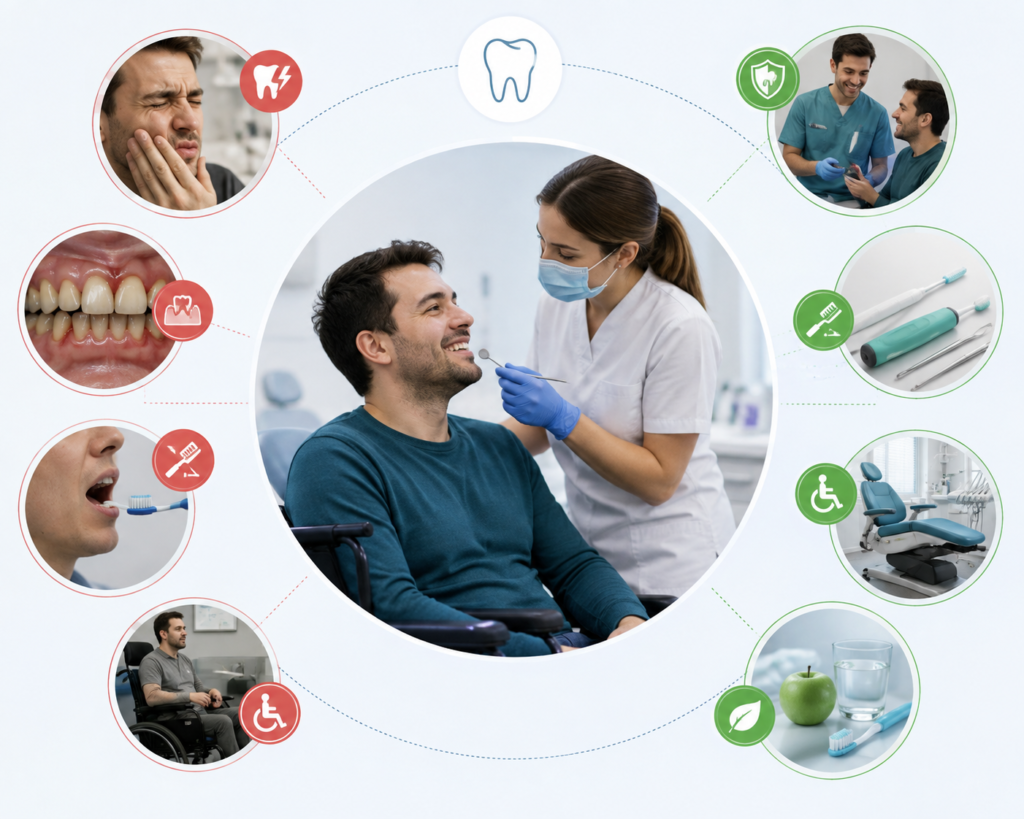
A routine cleaning can turn into a stressful ordeal for someone with sensory sensitivities, mobility limitations, or communication differences. This is the everyday reality for many disabled adults, and it’s exactly why families across Dubai search for a dentist for disabled adults who understands more than just teeth. Some are looking for a dentist for autistic adults who can adjust pacing and communication style. Others want a special care dentist in Dubai with real training in inclusive treatment, not just a friendly bedside manner. Being a certified autism center changes how a clinic approaches these appointments from the first phone call to the final checkup, and that difference is worth understanding before you book anything.
Why Standard Dental Visits Don’t Work for Everyone
Most dental clinics are built around a fairly narrow idea of what a “normal” patient looks like: someone who can sit still, follow verbal instructions, tolerate bright lights and unfamiliar sounds, and communicate discomfort clearly. That model breaks down fast for adults with autism, intellectual disabilities, cerebral palsy, Down syndrome, or physical mobility conditions.
The result is a pattern seen across the UAE and globally: disabled adults delay dental care far longer than they should, often until a small issue becomes a painful one. A dentist for disabled adults needs to rebuild the entire visit around the patient, not the other way around.
Sensory Overload Is the Biggest Barrier
For many autistic adults, a dental chair is a sensory minefield. The suction sound, the smell of antiseptic, the bright overhead light, the feeling of gloved hands in the mouth. Any one of these can trigger distress, and together they often do.
A dentist for autistic adults typically addresses this by:
- Dimming or adjusting lighting where possible
- Allowing noise-cancelling headphones or quiet music during treatment
- Introducing tools gradually instead of all at once
- Giving the patient control over breaks and pacing
- Using visual schedules or simple step-by-step explanations before starting
None of this is complicated equipment. It’s a change in approach, and it’s the difference between a five-minute checkup and a full-blown panic response.
Communication Gaps That Get Missed
Pain that isn’t described the way a textbook expects it to be often gets underestimated. A patient who can’t say “the lower left molar throbs when I chew” might instead pull away, refuse to open their mouth, or seem unusually withdrawn. Staff who aren’t trained in this read the behavior as non-cooperation rather than a legitimate signal of discomfort.
A special care dentist in Dubai is trained to interpret these cues correctly: body language, changes in breathing, repetitive movements, or sudden silence can all mean something. Getting this wrong doesn’t just cause a bad appointment. It can mean a genuine dental problem goes untreated for months.
Physical Access Is Still a Real Problem
Sensory and communication barriers get most of the attention, but physical access matters just as much for adults with limited mobility or those who use wheelchairs.
| Common Access Barrier | What It Means for the Patient |
| Narrow clinic entrances or steps | Difficulty entering the building at all |
| Fixed dental chairs | Inability to transfer safely without staff help |
| No transfer equipment or trained staff | Risk of injury during positioning |
| Rigid appointment slots | No buffer time for slower entry, transfers, or breaks |
A clinic that genuinely functions as a dentist for disabled adults builds these considerations into daily operations rather than treating them as exceptions.
Anxiety Built From Past Experiences
Many disabled adults arrive at a new clinic already carrying anxiety from previous visits where their needs weren’t understood, and this is especially common among patients who never found a dentist for autistic adults willing to slow down for them. A rushed dentist, an impatient assistant, or a single bad experience with restraint or forced treatment can create dental avoidance that lasts years.
Rebuilding trust takes longer than one appointment. It usually means:
- Shorter, more frequent visits at the start instead of one long procedure
- Letting the same dentist and team handle every visit
- Explaining each step before it happens, not during
- Never rushing a patient who needs more time in the chair
What a Certified Autism Center Actually Means
The term gets used loosely, so it’s worth being specific. A certified autism center designation, awarded through recognized training bodies like IBCCES, means staff have completed structured training in sensory awareness, communication strategies, and behavioral support specific to autism. It isn’t a marketing label. It reflects an actual curriculum that clinical staff have gone through.
At 21st Century Medicare Poly Clinic in Dubai Investment Park 1, this training sits alongside DHA regulation, so patients get both clinical accountability and inclusive care in the same place. The clinic’s founder, Dr. Emani, is IBCCES-accredited specifically in autism-friendly and special needs dentistry, which is part of why the practice holds its certified autism center status.
How Treatment Plans Actually Adapt
A dentist for autistic adults or any adult with a developmental or physical disability usually needs a plan that looks different from a standard treatment path:
- Pre-visit consultation to understand triggers, communication style, and past dental history
- Desensitization visits where the patient meets the team and the room without any procedure happening
- Flexible scheduling that avoids rushed slots and allows extra time
- Sedation options discussed openly for patients where cooperation isn’t realistic without it
- Family or caregiver involvement throughout, not just at intake
This is the core of what a special care dentist in Dubai is meant to offer: dentistry shaped around the patient instead of the other way around.

Getting the Right Care Doesn’t Have to Be a Struggle
Finding a dentist for disabled adults who takes sensory needs, mobility, and communication seriously shouldn’t require months of trial and error. 21st Century Medicare Poly Clinic in Green Community Village, Dubai, welcomes autistic adults and patients with a range of disabilities, with a team trained to adapt rather than expect the patient to adapt to them. If dental visits have been a source of dread for you or someone you care for, book a consultation and see what a genuinely inclusive appointment feels like.
Also Read : Dental Anxiety in Adults with Disabilities: How Specialised Dentists Make It Possible
Frequently Asked Questions
1. What makes a clinic qualify as a dentist for disabled adults?
It comes down to training and infrastructure: staff trained in communication adaptations and sensory awareness, flexible scheduling, and physical accessibility, rather than a clinic simply agreeing to treat a disabled patient without changing its approach.
2. Is sedation always necessary for autistic adult patients?
No. Many autistic adults manage dental visits well with sensory accommodations and a slower pace. Sedation is one option among several and is only used when cooperation isn’t realistic through other methods.
3. What does certified autism center status actually require?
It requires staff to complete structured training, typically through IBCCES, covering sensory processing, communication strategies, and behavioral support specific to autism, verified through an external certification process.
4. Can a dentist for autistic adults treat patients with other disabilities too?
Yes. The same core skills, patience, clear communication, sensory awareness, and flexible pacing, apply broadly to intellectual disabilities, cerebral palsy, and other conditions, not autism alone.
5. How long does a first appointment usually take at a special care dentist in Dubai?
Longer than a standard checkup. Many clinics schedule extended first visits specifically to allow time for the patient to acclimate to the room and team before any treatment begins.
6. Do caregivers need to stay in the room during treatment?
This depends on the patient’s preference and comfort level. Many clinics allow a caregiver to remain present throughout, particularly for the first few visits.
7. Are dental problems more common in disabled adults?
Delayed and avoided visits mean issues are often caught later, not that disabled adults are inherently more prone to dental problems. Consistent, comfortable access to care closes most of this gap.
8. What should I bring to a first visit with a dentist for disabled adults?
A summary of medical history, current medications, known sensory triggers, and any communication preferences helps the team prepare the visit properly in advance.
9. Does 21st Century Medicare Poly Clinic accept insurance for special needs dental care?
The clinic accepts insurance, and coverage details vary by provider and plan, so it’s worth confirming specifics with the clinic directly when booking.
10. How do I book an appointment with a special care dentist in Dubai at this clinic?
You can call the clinic directly to discuss the patient’s needs beforehand, which allows the team to plan the appointment length, environment, and approach in advance.